


Introduction: Photographing Bologna’s Medieval Towers — an Invitation for the Curious Eye
Bologna, the capital of Emilia-Romagna, is famous for its endless porticoes, rich cuisine and centuries-old university. Yet at the heart of the city rise silhouettes that tell the medieval story like few other urban features: the towers. These stone and brick blocks, built between the 11th and 13th centuries, were both family power statements and markers of a unique urban morphology. For any photographer — hobbyist or pro — exploring Bologna’s towers is stepping into a playground where architecture, light and everyday life combine to produce powerful, narrative images.
Contenu de l'article
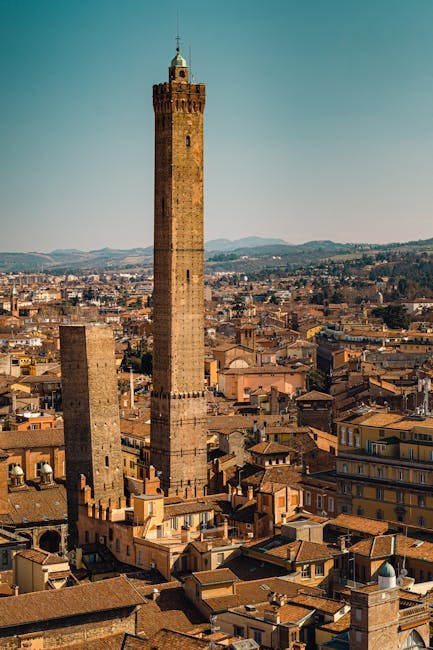
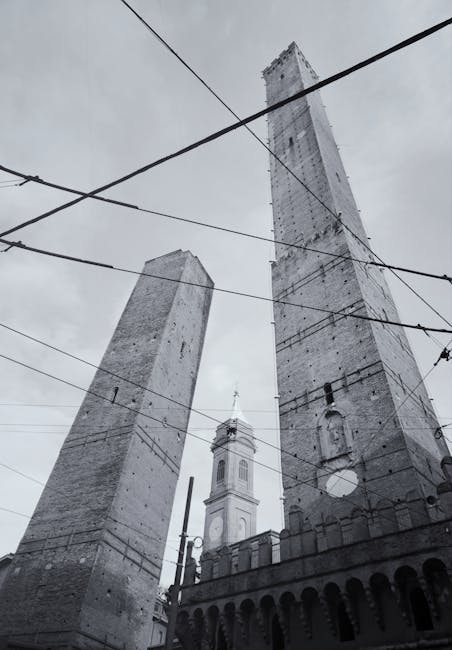
Shooting these towers requires more than good gear: you need to understand the city, its angles, its hours and how people use its spaces. The two most famous, the Torre degli Asinelli and the Torre Garisenda, stand in Piazza di Porta Ravegnana (address: Piazza di Porta Ravegnana, 2, 40126 Bologna BO, Italy). They’re the obvious starting point for a photo session, but Bologna hides other, less-known towers like Torre Prendiparte (accessible by guided tour), Torre Azzoguidi and Torre degli Ughi, each offering a different view of the city. Knowing how the towers are oriented to the sun, where to stand to capture brick textures, and which time of day to choose will turn a simple sightseeing stop into a coherent, memorable photo series.
This guide walks you through the process step by step: technical tips (lenses, settings, light management), practical routes (addresses, opening times, prices), and on-the-ground tricks to avoid crowds and respect local rules, including drone restrictions and paid access. You’ll find immersive descriptions, precise reference points (exact addresses and indicative times), and concrete advice to get the most out of each spot. Whether you’re drawn to twilight silhouettes, dramatic low-angle street shots, or panoramas from tower tops, this piece gives you the keys to photograph Bologna’s medieval soul with style and respect.
 Click here to join a photographic tour of Bologna
Why Bologna’s Medieval Towers Make Outstanding Photographic Subjects
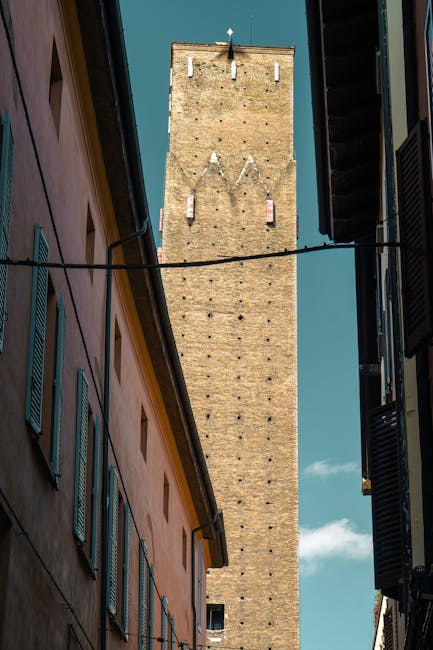
Bologna’s medieval towers are not isolated monuments: they are in constant visual dialogue with the city. Their vertical lines contrast with the horizontal sweep of the porticoes and roofs, creating strong compositional lines. The Torre degli Asinelli (Piazza di Porta Ravegnana, 2, 40126 Bologna BO) soars to 97.2 meters and offers a 360° panorama from its summit. The contrast between the intimacy of narrow streets and the wide-open views from the tops is a playground for different photographic approaches: textured details, environmental portraits, sunset silhouettes and broad urban landscapes.
The nearby Torre Garisenda is notable for its pronounced lean — it appears shorter because it visibly tilts — offering an almost caricatural subject for images that play with distortion and power dynamics. Up close, you’ll spot the patina on the bricks, repairs and modern insertions: historical clues that add a narrative layer to your pictures.
Smaller towers like Torre Prendiparte (address and access: Torre Prendiparte, Via Oberdan 6, guided access; booking recommended) allow for more intimate framing, shadow-and-light studies in inner courtyards, and spiral staircases. These spots are great for capturing rare architectural details — lintels, corbels, remnants of old plaster — that aren’t visible from the main squares.
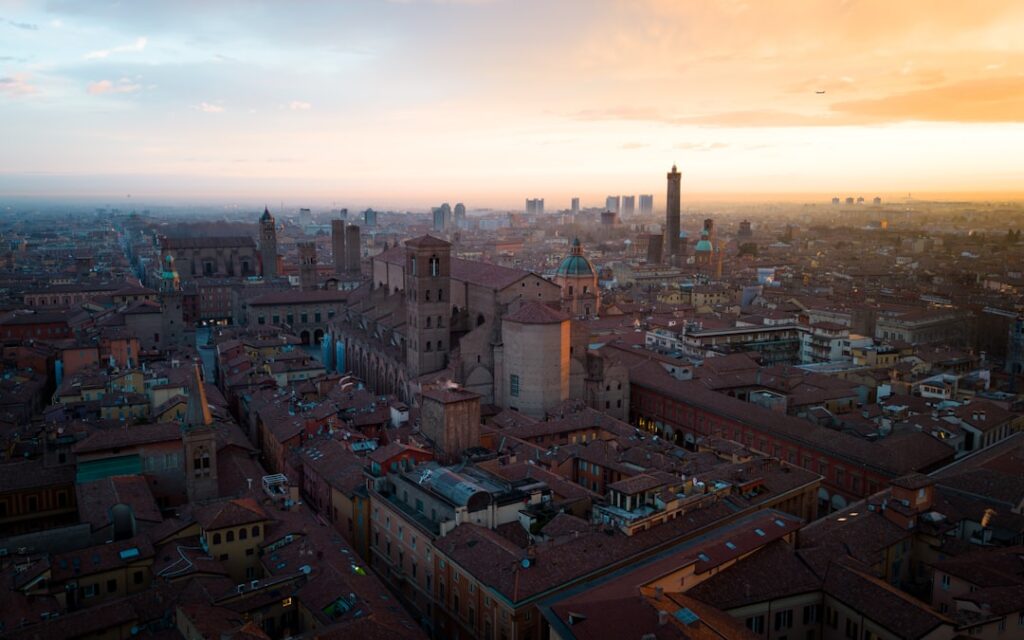
Another major photographic asset in Bologna is the light. In winter, dry air gives a cool, high-contrast tone that makes reds and ochres of the bricks pop; in summer, golden evening light enhances textures. Seasons alter the mood: morning mist over the roofs, stormy spring skies, or summer sunsets provide a varied palette. Taking these elements into account lets you build a cohesive series where each tower reveals a different facet of the city and its history.
Click here to discover Bologna from the tower and the Archiginnasio
Preparing Your Gear and Settings: Lenses, Filters and Techniques for Medieval Towers
To photograph Bologna’s towers effectively, keep your kit simple and versatile. Recommended setup: a full-frame or APS-C body, a wide-angle lens (16–35mm or equivalent) for low-angle street shots, a moderate telephoto (70–200mm) to isolate architectural details and compress perspective, and a fast prime (35mm or 50mm) for portraits or street scenes around the towers. Bring a small, lightweight tripod for long exposures at twilight and a remote shutter release to avoid camera shake.
Filters come in handy: a polarizer reduces reflections on glass and deepens colors, while a neutral density (ND) filter lets you smooth motion (people, cars) for long exposures from a square. In winter, a microfiber cloth and a moisture-protective cover are advisable because condensation can quickly dirty lenses when you access tower tops. Also pack spare batteries and memory cards; some guided tours are lengthy and you’ll want to shoot without running out of power.
Practical settings: during the day, aim for f/8–f/11 for overall sharpness on a tower. To isolate details, open up to f/2.8–f/4. In low light, raise ISO cautiously (800–1600 on a modern camera) and use a tripod for slow shutter speeds. To freeze silhouettes in daylight you may need 1/200 s or faster depending on focal length. For dramatic low-angle shots, use a fast shutter and tight framing to exaggerate verticality.
Creative techniques: try double exposures (in-camera or in post) to layer brick textures with human silhouettes. A vertical panorama shot from a distance will emphasize the disproportionate height of towers like Torre degli Asinelli. Above all, follow local rules: drone flights are strictly regulated in Italy and often forbidden in Bologna’s historic center; check with the National Civil Aviation Authority (ENAC) and municipal authorities before attempting any drone work. Access to interior staircases can also be restricted: heed guards’ instructions and posted signs to ensure safe and respectful shooting.
Suggested Photo Route: Addresses, Opening Times, Prices and Practical Tips
Here’s a one-day (or two-day) route to photograph Bologna’s main towers with addresses, indicative opening times and prices. Note that times and fees change by season; check official sites before you go.
- Piazza di Porta Ravegnana — Torre degli Asinelli and Torre Garisenda
Address: Piazza di Porta Ravegnana, 2, 40126 Bologna BO, Italy. Access: walkable from Stazione di Bologna Centrale (Piazza della Repubblica, 1, 40121 Bologna) in 15–20 minutes or reachable by bus. Hours (indicative): Torre degli Asinelli typically open daily from 9:30 to 19:00 (longer hours in summer), possibly closed outside peak season. Price: climb around €5–€8 for adults (reduced rates for students/children). Practical tip: arrive early (at opening) to avoid queues and capture morning light on the façades.
- Basilica di San Petronio — Piazza Maggiore
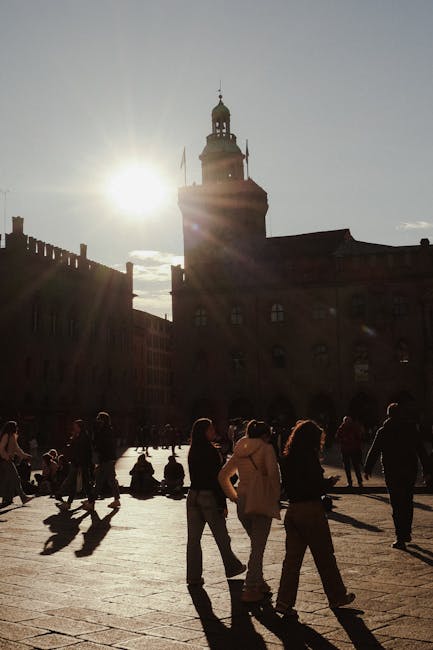
Address: Piazza Maggiore, 40124 Bologna BO, Italy. Hours: 9:00–18:00 depending on season; certain masses or events may restrict access. Entry price: basilica interior is generally free to visit, but some areas or exhibitions are paid (≈ €3–€6). Practical tip: from the square, frame the towers around the basilica at sunset to create a dramatic composition.
- Torre Prendiparte
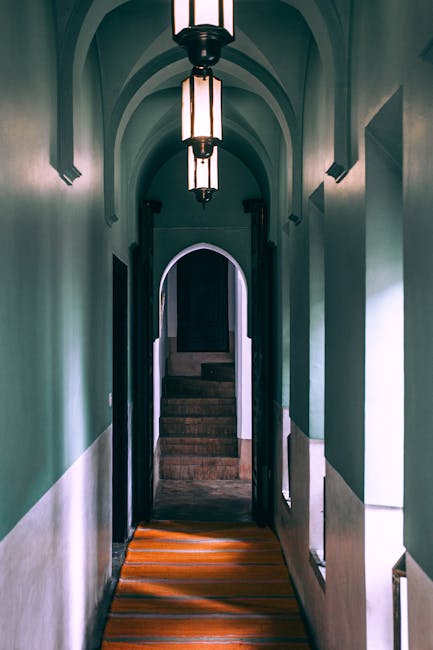
Address and access: Torre Prendiparte, Via Oberdan 6 (or Via Piella depending on entrance), 40126 Bologna BO. Hours: guided visits by reservation, several time slots per week (often late afternoon/early evening). Price: about €6–€10 depending on the package (guided tour + climb). Practical tip: book in advance via the official site or the local tourist office. The interior is a maze of wood and stone — bring a small flash for detail shots if light is limited.
- University Quarter — small towers and hidden courtyards
Key area: Via Zamboni and surroundings, 40126 Bologna BO. Hours: streets open 24/7, university museums vary (≈ 9:00–17:00). Price: street access is free; museums vary ≈ €2–€7. Practical tip: wander the alleys around the Università di Bologna (Piazza Verdi) to find modest towers framed by arcades — perfect for staged portraits or texture studies.
Transport and logistics: Stazione di Bologna Centrale (Piazza della Repubblica, 1, 40121 Bologna) is the main arrival point; from there most sites are walkable. Local buses run by TPER serve outer neighborhoods; a bus ticket costs about €1.50 for a limited time (≈75 minutes). For extra comfort, official taxis (look for « TAXI » signs and meters) run 24/7; rides into the center are roughly €8–€12 depending on distance.
Click here to discover Bologna from the tower and the Archiginnasio
Local and Ethical Tips: Encounters, Timing and Respecting the Heritage
Photographing Bologna’s towers also means photographing a living city. Respecting residents, shopkeepers and local rules is essential. Interior staircases are often narrow and busy; avoid blocking passages with bulky gear. Always check restrictions for photography: private owners and institutions may request permission for any commercial use of images. For night shoots, stay in public spaces and avoid disturbing neighbors with powerful lighting.
Meeting locals can enrich your images: ask permission before photographing people, offer to send the photo by email, and be ready to give a small digital copy. Traditional cafés around Piazza Maggiore and Via Rizzoli (for example, Caffè Terzi, Via degli Orefici 10, 40124 Bologna) are great vantage points to observe city life and capture authentic street scenes. Typical hours: 7:30–20:00; an espresso costs about €1.10–€1.80.
For your gear’s safety: avoid leaving bags on the ground in alleys, prefer an anti-theft bag and keep your camera strap across your body in front. Evenings can be lively, but don’t leave lenses visibly exposed. Finally, consider photographic equipment insurance if you travel with expensive gear.
Click here to savour Bologna’s specialties like a local
Conclusion: Building a Photographic Series Around Bologna’s Towers
Shooting Bologna’s medieval towers is both a technical and a poetic exercise. The strongest images often come from repeated observation: revisit the same tower at different times, study shadow movements, and note how seasons change colors and moods. The variety of towers — from landmark giants like the Torre degli Asinelli to small, tucked-away towers in university courtyards — lets you assemble a rich, varied series where each frame adds a new historical and human perspective.
By planning your route carefully (exact addresses, climb times, indicative fees), preparing the right gear (wide-angle, telephoto, tripod, filters), and respecting local rules (image rights, drone bans, conduct in public spaces), you’ll optimize your shooting sessions and avoid hassles. The practical tips here — booking Torre Prendiparte, arriving early at Piazza di Porta Ravegnana, using a tripod at dusk — are meant to maximize your visual opportunities while honoring the heritage and local community.
Finally, remember travel photography is a dialogue: between you, the light and the city. Take time to feel Bologna, listen to its sounds, taste its flavors (a plate of tagliatelle al ragù costs about €10–€15 in a local trattoria), and let those experiences inform your eye. The medieval towers are not mere subjects; they are silent witnesses to a living history. Treat them with curiosity, patience and respect, and your images will tell not only of the stones’ grandeur but of the life that surrounds them.