


Introduction — Bologna’s Communal Towers: a vertical history at the heart of the city
Bologna, the capital of Emilia-Romagna, is a city you read as much horizontally—its long arcades (the portici) and shopping streets—as vertically. Look up and you’ll find a skyline studded with medieval towers that tell a unique social, political and architectural story. These “torri” aren’t mere decoration: for centuries they formed a visual language expressing family prestige, rivalry between patrician clans, municipal power and the vagaries of war and time. Understanding the history of Bologna’s communal towers means diving into the medieval soul of a city whose urban fabric was shaped by family rivalries, technical innovations and later modern interventions.
Contenu de l'article
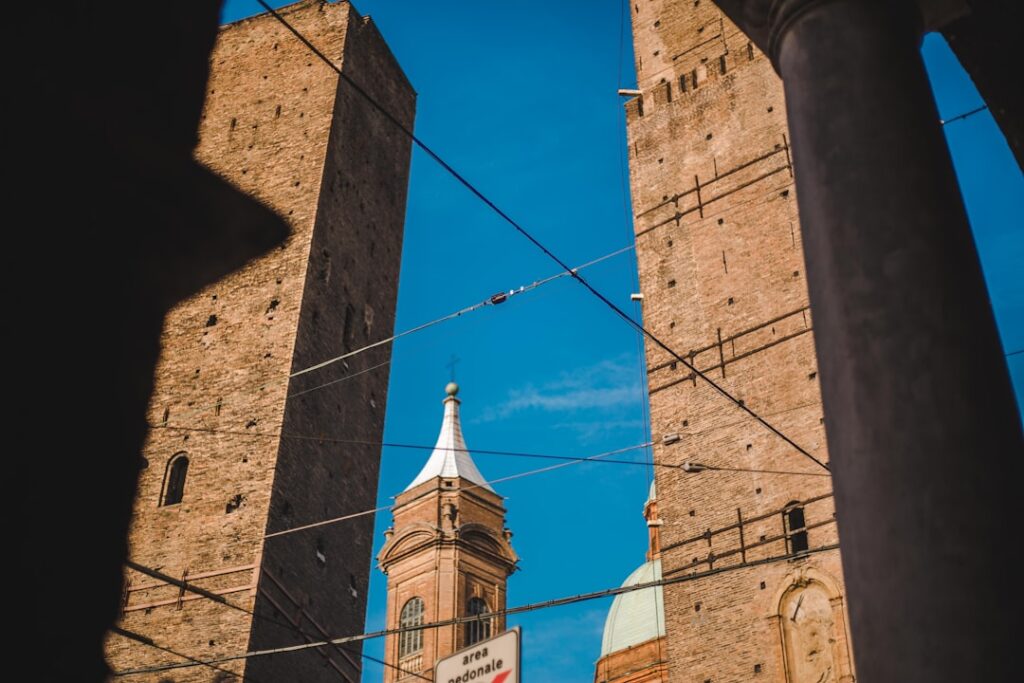
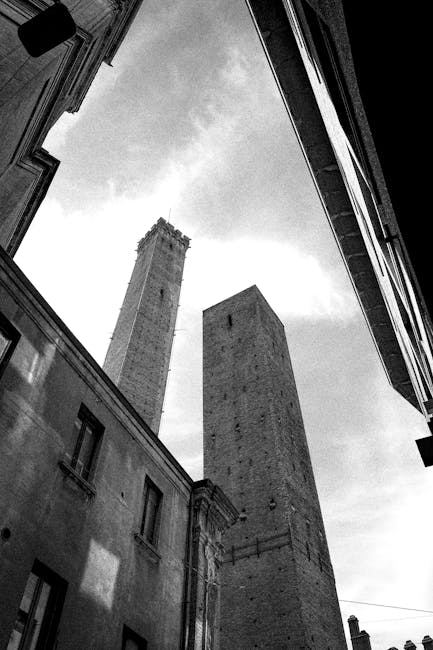
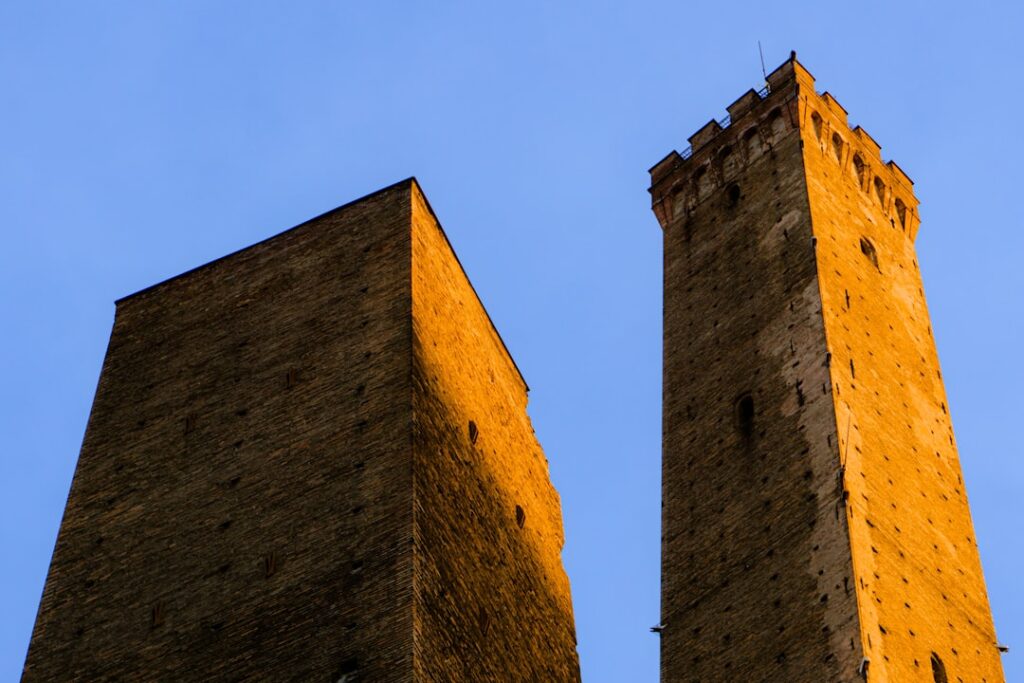
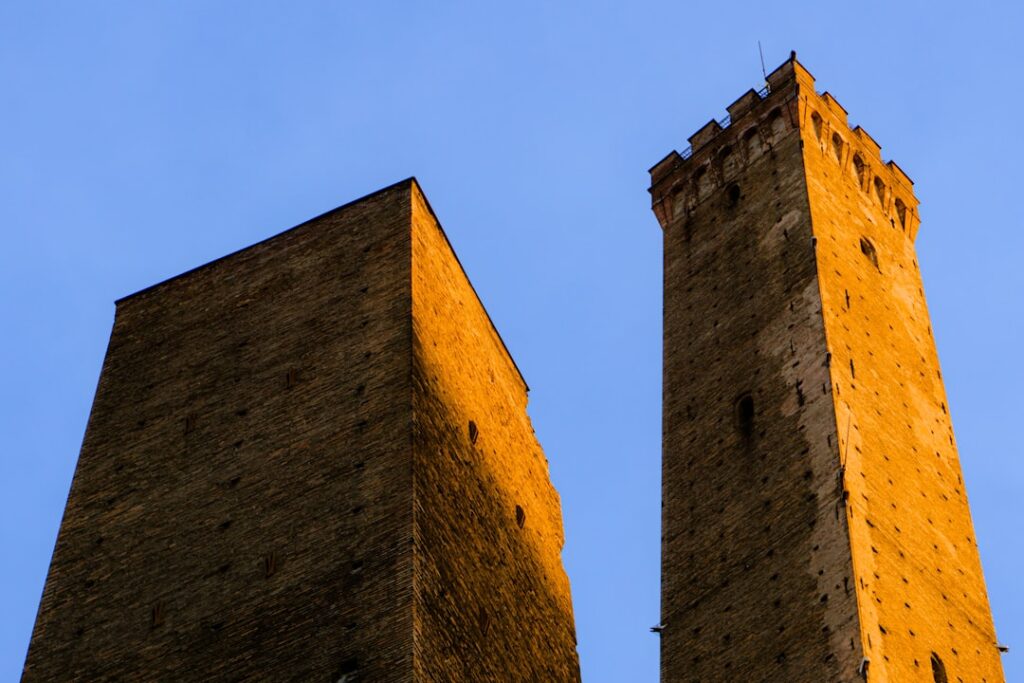
The most famous are the Torre degli Asinelli and the Torre Garisenda, standing where several main streets converge around Piazza di Porta Ravegnana. But the city once hosted hundreds of towers: in the 12th–13th centuries, there were likely several hundred scattered across the urban fabric. Some served as private fortifications, others as lookout posts, status symbols or shelters. Many were torn down, shortened, absorbed into palaces or stabilized through consolidation works. Today, the ones that remain form a network of historic landmarks that punctuate Bologna’s story—tall brick flames recalling times of civic fervor as well as technical fragility.
Visiting Bologna’s towers mixes historical curiosity with a sensory experience: feeling the roughness of the brick, climbing narrow staircases and hearing footsteps on steps worn by centuries of passage. It’s also an invitation to read the city in layers: among Renaissance façades, communal palaces (palazzi comunali) and basilicas, the towers tell how families competed and how municipal authority eventually imposed rules. In this article we’ll explore the history of the communal towers, their functions, their architecture, the associated monuments—like the Basilica di San Petronio and the Palazzo d’Accursio—and provide practical, up-to-date information for anyone wanting to see, climb and understand these vertical relics. Exact addresses, approximate current prices and usual opening hours are included to help plan your visit, along with local tips to make the most of this remarkable heritage.
Origins and functions of the communal towers: from the 12th century to municipal institutions
The earliest towers in Bologna date from the 11th–13th centuries, a period when northern Italy saw the rise of urban communes. Patrician families—often from mercantile, legal or prosperous artisan backgrounds—built towers as outward signs of power. These towers could originally reach 60 to 100 meters; the Torre degli Asinelli, now 97.2 meters tall, is an impressive remnant of this height competition. Towers served several functions:
- Defensive — they sometimes acted as fortified elements able to shelter defenders and resist attacks. Narrow openings and upper platforms made surveillance and counterattack easier.
- Symbolic — raising a tower was a way to show off wealth and status. The most powerful families displayed their dominance visually across the urban landscape.
- Residential and utilitarian — some towers contained apartments, storage spaces and wells. They could function as tower-houses, accommodating a family and its servants.
- Observation — thanks to their height, towers were used to watch troop movements, smoke or fires, and for signaling. This lookout function explains why several towers were built near main gates or at important crossroads like Piazza di Porta Ravegnana.
The architecture of these towers is primarily brick—an abundant local material that’s durable and easy to shape. Thick base walls, small windows and spiral staircases reflect a balance between security and practicality. Over time, communal authorities imposed rules: reducing maximum heights, requiring consolidations, even ordering partial demolitions to limit the influence of private families. These interventions altered the city’s silhouette but also helped preserve many structures, sometimes shortened or absorbed into municipal palaces.
Iconic towers and their urban context: where to see them, addresses and practical info
Among the most accessible and visited remnants, the Torre degli Asinelli and the Torre Garisenda are unmissable. They rise at the junction of several historic streets and serve as a key landmark for any route through the historic center.
Torre degli Asinelli
Address: Piazza di Porta Ravegnana, 40126 Bologna BO.
Access and price: Indicative rate (2024) around €5.00 for an adult ticket, with discounts for children and groups; payment often accepted in cash or by card at the onsite ticket office.
Usual opening hours: generally 9:00–19:00 in high season (April–September) and 9:30–17:30 in low season (October–March). It may be closed for private events or bad weather—check before you go via the ufficio turistico Bologna Welcome or the official page.
Immersive description: Climbing the 498 steps of the Torre degli Asinelli is both a physical challenge and a contemplative experience. The steep wooden-and-stone staircase leads to a platform that takes in the red roofs of Bologna, the endless arcades and, on clear days, the Apennines on the horizon. The ticket office is at the tower’s base, often near the historic pharmacy on the corner of the street.
Torre Garisenda
Address: Piazza di Porta Ravegnana, 40126 Bologna BO (a few steps from the Torre degli Asinelli).
Access and price: The Torre Garisenda leans significantly and, for safety reasons, is not open to the public for climbing. It can be admired from the square free of charge.
Hours: exterior viewing is available 24/7 from Piazza di Porta Ravegnana; nighttime lighting highlights it after dark.
Immersive description: Shorter and dramatically tilted, the Garisenda offers a striking contrast to the aristocratic verticality of its neighbor, the Asinelli. Standing beneath its slanted face you can sense centuries of stresses that warped the structure and see how the city has learned to live with this fragile heritage.
Other nearby historic landmarks
Basilica di San Petronio — Address: Piazza Maggiore, 40124 Bologna BO. Typical hours: 7:00–19:00 (times vary for chapel visits and the museum). Fee: entry to the basilica is free; visits to the terrace and some chapels may be ticketed (€2–5 depending on the exhibition).
Palazzo d’Accursio (Palazzo Comunale) — Address: Piazza Maggiore, 40124 Bologna BO. Hours: museum often open 10:00–18:00; variable admission (around €3–7 for permanent collections).
These monuments help situate the towers within Bologna’s civic and religious fabric: from Piazza Maggiore you can map routes linking squares, towers and palaces, stopping at museums and historic cafés along the way.
Conservation, risks and interventions: how the city protects its towers
Preserving the communal towers is an ongoing challenge. The materials involved (brick and historic mortars), combined with wind, rain and seismic activity, make regular maintenance essential. Municipal authorities, together with the Soprintendenze (heritage conservation services), carry out consolidation campaigns, compatible mortar injections, wall drying and safety measures for platforms open to the public.
Some towers, like the Torre Garisenda, have had several floors removed over the centuries to reduce collapse risk and comply with municipal regulations. Others have been incorporated into newer buildings, losing exterior masonry while keeping their structural cores. Contemporary interventions favor reversible methods and compatible materials, aiming to respect historical and technical authenticity.
For visitors, this means some towers may be temporarily closed for work. Before planning a climb, it’s wise to:
- Check the ufficio turistico Bologna Welcome website (www.bolognawelcome.com) or onsite information panels for current opening status.
- Consider accessibility: medieval towers often have steep stairs and are not suitable for people with reduced mobility.
- Respect safety and conservation rules: don’t stick stickers, avoid touching fragile elements and follow marked paths.
Practical tips for your visit: hours, tickets, routes and local food
To make the most of Bologna’s communal towers, here are some concrete local tips:
- Best time to climb the Torre degli Asinelli: early morning (right at opening) to avoid heat and crowds, or late afternoon for sunset over the rooftops. Midday can be very busy in high season. Arrive 15–30 minutes before closing to avoid being locked out by the ticket office.
- Tickets and payment: bring some small change, but most sites now accept card payments. Tickets for the Torre degli Asinelli are around €4–6 for an adult in 2024; discounts apply for students, under-18s and school groups.
- Suggested routes: start at Piazza Maggiore (Basilica di San Petronio, Piazza Maggiore, 40124 Bologna), then head to Piazza di Porta Ravegnana to see the Two Towers. From there, continue to the Quadrilatero for a food-focused loop through markets and delicatessens.
- Where to eat after your visit: try tagliatelle al ragù at a traditional trattoria like Trattoria di Via Dè Giudei (indicative address: a historic street in the center). For coffee or gelato, Via dell’Indipendenza and the small streets around Piazza Maggiore offer many options.
- What to wear and what shoes to bring: choose comfortable shoes with non-slip soles for climbing stone staircases. In summer bring water; in winter check the weather as the summit is exposed to wind.

Useful contact information
Ufficio turistico Bologna Welcome — Piazza Maggiore, 40124 Bologna BO. Hours vary: generally 9:00–18:00. Website: www.bolognawelcome.com. For up-to-date information on towers and museums, contact the tourist office desk or check information panels on site.
Conclusion — Reading Bologna through its towers: vertical memory and contemporary emotions
Bologna’s communal towers are a heritage that is both tangible and narrative: they embody power struggles, medieval building practices and an urban history that has crossed into modern times. Climbing the Torre degli Asinelli, admiring the Torre Garisenda from Piazza di Porta Ravegnana or wandering streets that were once lined with hundreds of towers are different ways to engage with the past. These monuments invite a vertical reading of the city, where history is written in elevation and every stone holds the memory of conflict, prosperity or municipal intervention.
For the curious traveler, the towers offer a sensory route: the physical effort of the climb, the panoramic views, the texture of the walls and the proximity of civic sites like the Basilica di San Petronio (Piazza Maggiore, 40124 Bologna) and the Palazzo d’Accursio (Piazza Maggiore, 40124 Bologna). They also raise contemporary questions about conservation and accessibility, reminding us that preserving these vertical volumes requires technical expertise and political will. Before you go, take time to verify opening hours and prices (notably for the Torre degli Asinelli: Piazza di Porta Ravegnana, 40126 Bologna — indicative price ~€5.00), heed conservators’ instructions and use local routes to combine the useful with the enjoyable: history, vistas and gastronomy in one itinerary.
Ultimately, visiting Bologna’s communal towers isn’t just about ticking off sights on a list: it’s about immersing yourself in centuries of family and municipal stories, experiencing the city physically and intellectually, and bringing home images—of stone, brick and sky—that capture a city proud of its vertical legacy. Enjoy your discovery and don’t forget to look up.