


INTRODUCTION
Bologna is a city where medieval history is written in stone, in its ancient arcades and, above all, in the slender silhouettes of its towers. Between the 11th and 13th centuries, noble families and guilds competed in daring and height: building a tower was often enough to broadcast power and wealth. Today many of these structures still stand, offering visitors a direct plunge into medieval Bologna, where civic ambition, urban clashes and family prestige were read vertically. In a city that has preserved its historic fabric while staying lively and contemporary, these towers serve as urban landmarks, exceptional viewpoints and, occasionally, as museums or unusual places to stay.
Contenu de l'article
This article gives you an overview of the “Top 10 must-see medieval towers in Bologna.” The goal is twofold: help you spot the most emblematic monuments and give practical, ready-to-use information — exact addresses, typical opening times, admission prices in euros, visiting tips and local tricks to skip crowds or catch the best light for photos. Whether you love architecture, are a photographer looking for city panoramas, or a curious traveler wanting to understand the city at the pace of its stone staircases, you’ll find immersive descriptions and local recommendations here.
Each monument is presented in detail: historical origins, architectural features, access information, constraints (narrow stairs, number of steps, no elevator), recommended viewpoints, best times to visit (sunrise or sunset, ideal weather) and suggested routes to link several sites on the same walk. As a bonus, I share practical tips on transport, safety and heritage respect — essential to enjoy these monuments while helping preserve them. Finally, a few visual markers

were placed at strategic points to help you imagine the atmosphere.
Important: the opening hours and prices shown in this article are the most commonly displayed to the public, but can change depending on season, public holidays and cultural events. Before you go, I recommend checking official sites or calling tourist offices. With that sorted, lace up your walking shoes, grab a water bottle and bring your curiosity: let’s go discover the towers that make Bologna’s medieval heart beat.
Top 10 must-see medieval towers in Bologna
1. Torre degli Asinelli (Piazza di Porta Ravegnana, 40126 Bologna)
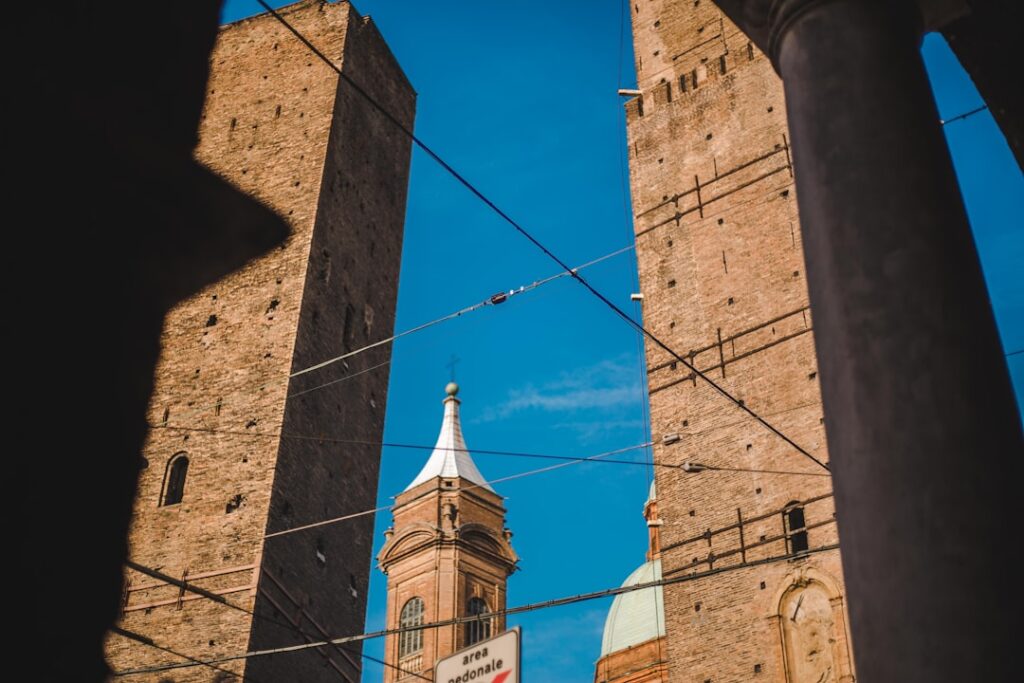
The Torre degli Asinelli is arguably Bologna’s most famous tower: tall and proud, it dominates Piazza di Porta Ravegnana and has served as a visual landmark for centuries. Exact address: Piazza di Porta Ravegnana, 40126 Bologna BO. The tower forms the “Due Torri” pair with its neighbor, the Garisenda. Built between 1109 and 1119, the Torre degli Asinelli rises to about 97.2 meters (historically accepted approximate height) and features a narrow staircase of 498 steps that leads to a viewing platform with 360° views over the city’s red roofs, the Emilia hills and, on clear days, the Apennines.
Practical info: admission (indicative): around €5.00 per adult; discounts for students and seniors (often €3.00). Opening hours (indicative): open daily 09:00–19:00 (extended hours in summer; may close in heavy rain or for maintenance). Allow 20–40 minutes for the climb, photos and descent if you’re not rushed.
Tips: the staircase is narrow, there’s no elevator, and it can be disorienting for those prone to vertigo: wear light clothing, avoid bulky bags and aim for less busy times (09:00–10:30 or 16:00–18:00). Climb on the left if you want to dodge groups and book in high season if possible. Outside, the square is full of cafes and shops; for a great shot, stick around for sunset when the façade takes on a warm hue. Nearby: Piazza Maggiore is a 7–10 minute walk.
 Click here to book a tour with views of the Tower and the Archiginnasio
2. Torre Garisenda (Piazza di Porta Ravegnana, 40126 Bologna)
A twin — but different — to the Torre degli Asinelli, the Torre Garisenda is famous for its pronounced lean. Address: Piazza di Porta Ravegnana, 40126 Bologna BO (same square as the Asinelli). Partly reduced in height over the centuries for safety reasons, the Garisenda now reaches about 48 meters and shows a visible tilt to the naked eye. Unlike the Asinelli, the Garisenda is not open for regular public climbs: it’s there to be observed, photographed and studied.
Practical info: free public access to admire it from the piazza; no regular interior visits (closed to the public for structural reasons). Hours: exterior viewing 24/7, be mindful of nighttime lighting. Safety tips: don’t touch areas protected by barriers and respect conservation signage.
Immersive take: standing between the two towers and feeling the contrast between Asinelli’s vertical thrust and Garisenda’s curve places you in the middle of a medieval scene. Perspective from Via Rizzoli or Via Zamboni accentuates the tilt; for photographers, the night illumination of the façades creates a dramatic atmosphere. Nearby: postcard shops, historic cafés and the covered passage of Via dell’Archiginnasio are just steps away.
3. Torre dei Prendiparte (Via de’ Prendiparte, 2, 40124 Bologna)
The Torre dei Prendiparte (also known as Torre Prendiparte) is one of the rare towers that combine visits with accommodation: a small guest structure sometimes offers bookings to sleep in the tower, providing a unique medieval experience. Exact address: Via de’ Prendiparte, 2, 40124 Bologna BO. Dated to the 12th century, the tower belonged to the Prendiparte family and still retains medieval elements visible in its upper structure.
Practical info: guided tours or climbs may be possible depending on the opening of the property/rooms; indicative visit fees: €4.00–€6.00; for a night (if available): from €90.00 for a double room depending on season. Visiting hours: often 10:00–13:00 and 15:00–18:00, but vary widely with private management; booking at least 48 hours in advance is recommended.
Immersive description: access is through a medieval door, then a narrow stone stair that leads to bedrooms and small lounges with exposed beams. Height is modest (around 20–30 meters depending on sources), but the experience is extremely intimate: sleeping in a medieval tower means accepting the scent of old wood, spiral stairs and direct views over tiled roofs. Local tips: check accessibility (stairs only), heating availability in winter and internet connection if you need it; for photographers, morning light through the windows is particularly soft.
4. Torre dell’Arengo / Palazzo d’Accursio (Piazza Maggiore, 6, 40124 Bologna)
The Torre dell’Arengo is associated with the Palazzo d’Accursio (or Palazzo Comunale), the historic seat of municipal authorities. Address: Piazza Maggiore, 6, 40124 Bologna BO. Though the palace today houses the Museo Civico of art and local history, the tower retains its symbolic role and, at times, is opened to visitors for exhibitions or occasional climbs.
Practical info: access to the Museo Civico and palace visit: indicative fee €6.00–€8.00 for permanent exhibitions; museum hours: generally 09:30–19:30 (closed Monday or variable public holidays). Climbing Torre dell’Arengo is often available only during special guided tours: check with the Museo Civico (tel. +39 051 …) or the local tourist office.
Immersive description: the tower overlooks the grand Piazza Maggiore, the city’s living heart: cafés, terraces and the rhythm of seasonal markets. From the upper windows you take in San Petronio Basilica, Neptune’s Fountain and the maze of medieval streets. Tips: combine this visit with San Petronio (Piazza Maggiore) and the Biblioteca Comunale dell’Archiginnasio for a full day; bring ID if you join a guided tour; aim for morning visits for photos without crowds.
Click here to book a walking tour of the historic center

5. Torre dei Galluzzi (Borgo di San Pietro area, Via San Donato nearby)
The Torre dei Galluzzi is a typical example of a medieval tower absorbed into the façade of a later building. General location: Borgo di San Pietro / Via San Donato area (near the historic center) — exact address to be confirmed on site depending on public access. The Galluzzi were an influential Bologna family, and their tower shows the urban layering where medieval structures are overlaid by later changes.
Practical info: free exterior viewing; interior access may be limited or reserved for private events. No standard fees or regular public hours. Immersive description: wandering the small streets off Via San Vitale you come across wall sections, blind arches and towers partially integrated into houses. These discoveries require a slow pace and a curious eye: look for restoration marks, carved stones and the way medieval openings have been transformed.
Local tips: to spot the Torre dei Galluzzi and other lesser-known towers, pick up a historic map or join a themed guided walk “towers and noble houses.” Morning light on the alleys brings out texture and relief in the stones; avoid rainy afternoons when narrow passages get slippery.

6. Torre dei Ricci (near Via Rizzoli, central historic area)
The Torre dei Ricci is one of the many towers from lesser-known families that survive in the city’s core. Located near Via Rizzoli, its wall section and medieval foundations are visible from the street. Indicative address: Via Rizzoli / Via Oberdan area, 40126 Bologna — check local info plaques for precise details. The tower testifies to the medieval profusion: hundreds of towers, large and small, once dotted the city.
Practical info: free public observation; no regular interior visits. Like many others, this tower has often been incorporated into more modern buildings with restored façades. Immersive description: as you approach, notice the mortar joints, irregular brick patterns and how the tower acts as a visual “screen” relative to nearby streets: it visually controls its surroundings and sometimes houses shops at ground level.
Tips: pair a stop at the Torre dei Ricci with a visit to Galleria Cavour or a coffee on Via Farini. Quiet photo times are early morning (07:30–09:00) or evening after 19:30; side light from the sun reveals the brick textures.
7. Torre di Palazzo della Mercanzia (Piazza del Mercato area, near Via D’Azeglio)
The Palazzo della Mercanzia (also called the Loggia della Mercanzia) is a medieval building tied to Bologna’s commercial life and features an associated tower or bell tower. Address: Piazza del Mercato / Via D’Azeglio area, 40123 Bologna (historic center). The complex illustrates the economic and legal role of a mercantile city: fairs, commercial courts and merchants’ offices were organized here.
Practical info: access to historic rooms is often tied to temporary exhibitions; indicative guided tour fees: €4.00–€7.00; typical exhibition hours: 10:00–18:00, but these can vary. Immersive description: the palace’s tower offers a reading of civic medieval architecture, with late Gothic elements, sculptural motifs and proximity to still-active markets. The ancient commercial hub has often retained its social function: surrounding cafés keep a marketplace vibe.
Tips: combine the visit with a local market if available, taste Bologna specialties (mortadella, tagliatelle) in nearby trattorie, and check temporary exhibition schedules — some of the best finds come from one-off cultural events.
8. Torre della Specola (Observatory Tower, Via Zamboni 33, 40126 Bologna)
The Specola is a tower linked to Bologna’s scientific history: originally an observatory and astronomical watchtower, it marks an interesting crossroads between medieval heritage and Renaissance science. Address: Museo della Specola, Via Zamboni 33, 40126 Bologna BO (historic seat). The site has ties to the University of Bologna and, although it evolved, it keeps elements of observation towers.
Practical info: the Museo della Specola (or associated historical collections) occasionally offers visits with paid entry: indicative fee €6.00–€8.00; usual opening hours: 09:00–17:00 (closed some days — check before you go). Climbing the tower may be possible during specific guided visits.
Immersive description: imagine astronomers peering at the sky from a stone balcony above the rooftops — the tower acquires a poetic dimension where knowledge and verticality meet. The related collections (old instruments, globes, manuscripts) enrich the visit. Tips: book a guided tour to reach areas normally closed to the public; twilight often gives a special mood for photos merging sky and city.

9. Torre dei Canonici (near Basilica di San Francesco, Via Farini area)
The Torre dei Canonici, close to the Basilica of San Francesco and the former collegiate canon area, is a remnant of a medieval religious and administrative complex. Location: Via Farini / Basilica di San Francesco area, 40124 Bologna — exact address depends on cloister access. Within such compounds, towers served as defensive spaces, rooms and ancillary bell towers.
Practical info: interior access often comes as part of church and cloister visits; indicative entry fee for the basilica or a guided visit: €3.00–€6.00; typical hours: 09:00–12:30 and 15:00–18:00 (vary with religious services). The tower itself may be closed permanently to the public or opened occasionally.
Immersive description: proximity to the basilica and cloisters adds a sacred atmosphere: stones worn by generations of pilgrims, frescoes and pointed arches. The Canonici tower testifies to the role of canons in urban organization. Tips: respect service times, plan your visit during quiet moments (before mass), and enjoy the inner gardens for a peaceful break away from traffic.

10. Torre dell’Orologio / Torre dell’Argento (Clock Tower at Palazzo Communale area)
The Torre dell’Orologio is often tied to the civic clock and public functions of the town hall. Located in the area of the municipal palace and main squares (Piazza Maggiore / Palazzo Comunale), it was used to mark the rhythm of urban life. Address: Piazza Maggiore / Palazzo Comunale area, 40124 Bologna BO. Over time, the tower tells the story of municipal clockworks and bells.
Practical info: interior visits and access to the clock mechanism can be arranged via the Museo Civico or municipal offices; indicative thematic guided tour fees: €5.00–€10.00; hours vary with cultural programming. If climbing is allowed, the view includes the square and surrounding rooftops.
Immersive description: hearing the mechanism, seeing the gears and climbing up to the bell room gives a rare closeness to urban history: the clock is not just a measure of time, it’s a political and social instrument. Tips: opt for guided tours to understand the clock’s history and ask about recent restorations; be aware of narrow access and safety restrictions for children.
CONCLUSION
Bologna’s medieval towers are more than architectural curiosities: they are vertical memories, signs of power, culture and ingenuity written in the city’s stone and sky. From the majestic Torre degli Asinelli, which offers an essential panorama, to small façade-integrated towers like the Torre dei Galluzzi or Torre dei Ricci, every visit reveals a different facet of Bologna’s past — civic to religious, mercantile to scientific. These towers invite visitors to slow down and read details: joints, bricks, arches and inscriptions that tell stories of family alliances, urban conflicts and architectural evolution.
To make the most of these discoveries, follow a few simple rules: always check hours and prices before you go (many towers have seasonal hours or are accessible only during guided tours), avoid peak times for photography (prefer early morning or sunset), wear suitable shoes (stone stairs, uneven steps), respect barriers and conservation rules, and consider supporting local cultural venues by taking paid tours or buying museum tickets.
Click here to book a guided tour of Bologna with a certified guide
Finally, don’t limit yourself to climbing the tallest tower: walk the streets, stop in a trattoria, listen to locals, leaf through old guidebooks and look at towers from different viewpoints (courtyards, squares, terraces) to enrich your experience. Bologna is discovered both at eye level and from the height of its towers: each, spectacular or discreet, adds a stone to the story of a city that has combined its medieval past with a vibrant cultural and university life. Have a great trip and enjoy exploring Bologna’s skyline!